05/14/2026
|
Private Aviation Guide — Greece 2026
Greece Private Aviation Cost-Benefit Guide 2026
Helicopter vs Ferry vs Commercial Flight vs Private Jet — Cost, Time, Group-Size and Operational Comparison
By Grigoris Efthimiou | Founder & CEO, Fly G Aviation | Licensed pilot with 30+ years of Greek aviation experience
Last updated: May 2026 | Reading time: approximately 20 minutes
|
|
€426
Example/person*
|
35–65 min
Most Cyclades Routes
|
35–55%
Indicative Empty Leg Saving
|
30+
Years Greek Aviation
|
*Derived example only: 6 passengers on an Airbus H135, Athens–Mykonos, full aircraft, empty-leg availability. Empty legs are not guaranteed and remain subject to aircraft availability, passenger load, luggage, routing, weather and operational approval.
Direct Answer
A private helicopter transfer in Greece becomes cost-effective when time, group size and access matter more than the lowest ticket price: typically for 4–6 passengers, yacht connections, luxury resort arrivals, islands without commercial airports, and time-critical Greek island travel.
Ferries remain the lowest-cost option, commercial flights work well for major islands, private jets suit airport-to-airport or international sectors, and private helicopter transfer in Greece is strongest for direct Athens helipad to Greek islands routing using twin-engine EASA-certified aircraft such as the Airbus H135 and Airbus AS355 TwinStar.
|
|
EASA-certified aircraft arranged through certified partner operators | Private helipad approximately 15 minutes from Athens International Airport | Twin-engine Airbus H135 and Airbus AS355 TwinStar for overwater Aegean routes | Pricing examples are per aircraft, VAT included, one-way unless stated otherwise
|
TL;DR — Key Takeaways
✓ Ferry travel is normally the lowest-cost option for Greek islands, especially for budget-focused travellers with flexible time.
✓ Commercial flights are practical for major islands such as Mykonos, Santorini, Corfu, Rhodes and Kos, but they do not serve many smaller Cyclades destinations.
✓ Private helicopter transfer in Greece becomes most rational for 4–6 passengers, fixed arrival windows, yacht connections, high-value time, and islands without commercial airports.
✓ Empty-leg flights can reduce helicopter cost, usually for flexible travellers, but they are availability-based and should never be treated as guaranteed inventory.
✓ Fly G Aviation provides or arranges flights using EASA-certified helicopters and airplanes through certified partner operators.
✓ For overwater Aegean routes, Fly G Aviation works with twin-engine Airbus H135 and Airbus AS355 TwinStar aircraft, subject to aircraft availability and operational approval.
|
|
“After three decades in Greek aviation — from Mykonos at peak August to quieter island routes in the shoulder season — I have seen many travellers make transport decisions with incomplete information. This guide is designed to make those decisions clearer.”
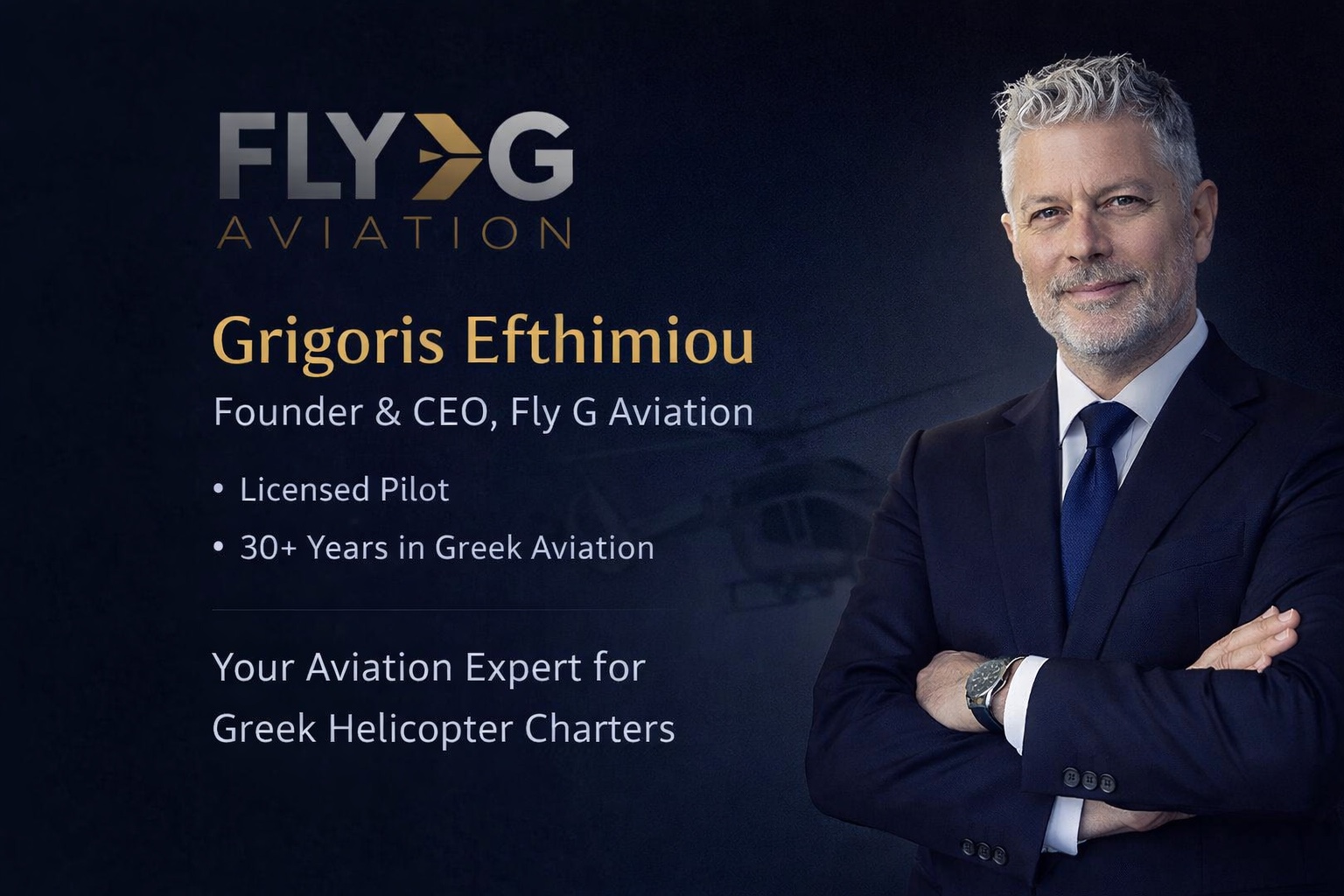
— Grigoris Efthimiou, Founder & CEO, Fly G Aviation BIO
|
|
Every year, travellers arrive in Athens and face the same operational question: how should they reach the Greek islands in a way that matches their budget, schedule, group size and tolerance for friction?
The usual answers — ferry, domestic flight, private jet or helicopter — each have a place. A ferry may be completely logical for a relaxed, low-cost itinerary. A commercial flight may work well for a solo traveller going to a major island airport. A private jet may be the correct solution for an international airport-to-airport sector. A helicopter becomes compelling when direct routing, time control and group logistics carry real value.
This article is a Greece private aviation cost-benefit guide, not a replacement for the official Fly G Aviation pricing hub. The figures below are selected examples designed to show the logic behind a transport decision. For the full current route table, use the official pricing page linked later in this guide.
Fly G Aviation is based in Athens, Greece. Fly G Aviation provides EASA certified helicopters and airplanes and arranges private aviation services through certified partner operators.
|
2. The Greek Island Transport Landscape in 2026
|
The Core Problem
Greece has many island destinations, but not all have airports, not all airports have convenient schedules, and not all ferry routes work for travellers with limited time. The islands that premium travellers most often want — Mykonos, Santorini, Paros, Sifnos, Antiparos, Patmos, Ios and smaller Cyclades destinations — may look close on a map but can involve very different travel realities.
Key planning facts:
► Ferries are normally the lowest-cost solution, but they can require several hours door-to-door, plus port transfers and boarding time.
► Commercial flights serve major island airports, but not smaller Cyclades islands such as Sifnos, Antiparos, Folegandros or Kimolos.
► Peak-season airport and port congestion can add meaningful time to routes that appear short on a timetable.
► A private helicopter transfer in Greece can connect a private Athens helipad with many Greek islands in roughly 20–90 minutes of flight time, depending on routing and approvals.
► Fly G Aviation departures are arranged from a private helipad approximately 15 minutes from Athens International Airport.
|
| Mode |
Typical Best Use |
Main Limitation |
| Standard ferry |
Lowest-cost travel, flexible schedules, heavy luggage |
Long door-to-door journey and weather disruption risk |
| High-speed ferry |
Cost-conscious travel to popular islands |
Can be affected by Aegean wind and port congestion |
| Commercial flight |
Major islands with airports, solo travellers, budget control |
Airport procedures, fixed schedules, no service to many islands |
| Private helicopter transfer |
Groups, yacht links, luxury resorts, islands without airports, urgent travel |
Higher aircraft cost and operational approval requirements |
| Private jet |
International or airport-to-airport travel |
Requires airport infrastructure and usually cannot solve final-island access |
Indicative comparison only. Actual suitability depends on date, route, passenger count, luggage, weather, aircraft availability, airport/helipad approvals and certified partner operator assessment.
3. Cost Breakdown by Transport Mode
|
3.1 Ferry: Lowest Ticket Cost, Higher Time Cost
Ferries are essential to Greek island travel and remain the best low-cost option for many travellers. The true cost, however, should include port transfers, early arrival time, boarding, disembarkation, possible delays and the value of the hours spent in transit.
|
| Example Route |
Indicative Ferry Time |
Indicative Ticket |
| Athens / Piraeus to Mykonos |
Approximately 2.5–5+ hours by ferry, before ground logistics |
Often €60–140 for high-speed services, date dependent |
| Athens / Piraeus to Santorini |
Approximately 5–9+ hours depending on vessel |
Often €70–160, cabin or premium seating extra |
| Athens / Piraeus to Sifnos |
Approximately 3–6+ hours depending on service |
Often lower than aviation options |
3.2 Commercial Flights: Strong for Major Islands
Commercial flights work well for travellers going to island airports such as Mykonos, Santorini, Corfu, Rhodes, Kos or Chania. They become less useful when the final destination has no airport, when the group needs to stay together, or when the schedule is time-critical.
|
| Route Type |
Where It Works |
Where It Fails |
| Major island airport |
Mykonos, Santorini, Corfu, Rhodes, Kos |
Airport queues, schedule limits, baggage collection and onward transfer |
| No-airport island |
Not available as a direct commercial option |
Requires ferry or private helicopter transfer |
3.3 Private Helicopter Transfer: Selected Example Routes
The following are selected example routes, not the complete pricing hub. They are included to show the cost-benefit logic of private helicopter transfer in Greece. For the official current table, visit the Fly G Aviation helicopter destinations and prices hub.
All examples are indicative, per aircraft, VAT included, one-way, and subject to aircraft availability, passenger load, luggage, routing, weather, helipad/airport permissions and operational approval.
|
| Example Route |
Aircraft Example |
Example Price |
Indicative Flight Time |
| Athens helipad to Kea |
Airbus AS355 TwinStar |
from €2,352 per aircraft |
18–21 minutes |
| Athens helipad to Mykonos |
Airbus H135 / AS355 TwinStar |
from €4,350–€4,650 per aircraft |
35–40 minutes |
| Athens helipad to Paros |
Airbus H135 / AS355 TwinStar |
from €4,820–€5,120 per aircraft |
about 35 minutes |
| Athens helipad to Sifnos |
Airbus H135 / AS355 TwinStar |
from €4,950–€5,200 per aircraft |
about 35 minutes |
| Athens helipad to Santorini |
Airbus H135 / AS355 TwinStar |
from €6,350–€6,900 per aircraft |
about 55–65 minutes |
| Athens helipad to Patmos |
Airbus H135 / AS355 TwinStar |
from €6,778–€7,060 per aircraft |
about 60 minutes |
For complete 2026 route pricing, see the official Fly G Aviation helicopter destinations and prices page.
| Athens to Mykonos Example |
Group of 4 |
Group of 6 |
| AS355 example at €4,350 per aircraft |
€1,088 per person derived example |
Not applicable for 6 passengers; AS355 seats up to 5 |
| H135 example at €4,650 per aircraft |
€1,163 per person derived example |
€775 per person derived example |
4. Empty Legs: An Availability-Based Option
|
What Is an Empty Leg?
An empty leg is a positioning sector where an aircraft needs to move without booked passengers, for example after a drop-off or before the next confirmed pickup. Certified partner operators may make these sectors available at reduced rates when the timing, route and permissions align.
Empty legs can create strong value, but they are not guaranteed. They are best for flexible travellers who can adapt by one to three days and who understand that confirmation may depend on a wider aircraft schedule.
Why Greece can create empty-leg opportunities:
► Athens is a major private aviation coordination point for the Greek islands.
► Popular island flows can create positioning flights between Athens, Mykonos, Santorini, Paros and yacht destinations.
► Peak-season demand may increase aircraft movements, but it does not guarantee empty-leg availability on a specific date.
|
| Aircraft Type |
Indicative Standard Range |
Indicative Empty-Leg Saving |
| Twin-engine helicopter |
Route dependent |
Often 35–55% when available |
| Private jet |
Aircraft and airport dependent |
Possible, but route and timing dependent |
|
Empty-Leg Planning Formula
Indicative empty-leg value = standard aircraft price minus any availability-based discount, plus any added ground, waiting or schedule-adjustment cost.
Empty-leg examples are indicative only. Final confirmation depends on aircraft schedule, route, passenger load, luggage, weather, permissions and certified partner operator approval.
|
| Athens to Mykonos Empty-Leg Example |
Standard Example |
Indicative Empty-Leg Example |
| AS355 aircraft cost |
from €4,350 per aircraft |
Possible reduced rate when available |
| H135 6-passenger derived example |
€775 per person at full capacity |
about €426 per person at 45% saving, if available |
|
Ask About Empty-Leg Availability
Flexible dates can sometimes unlock availability-based savings. Empty legs are never guaranteed.
Email sales@flyg.gr |
5. The Time Value Equation
|
|
A transport decision is not only a ticket-price decision. The relevant calculation is the combined value of ticket cost, aircraft cost, hours consumed, reliability, luggage complexity, passenger comfort and the consequences of delay.
True Transport Cost = Direct Cost + Time Cost + Friction Cost + Delay Risk
For a family, friction may mean children, luggage and port queues. For a business group, it may mean lost meeting time. For a yacht guest, it may mean missing a narrow embarkation window. This is where the economics of a private helicopter transfer in Greece can change.
|
| Traveller Type |
Time Sensitivity |
Likely Best Option |
| Solo leisure traveller |
Usually low to moderate |
Ferry or commercial flight |
| Family of 4–6 |
Moderate to high |
Helicopter when schedule and comfort matter |
| Executive group |
High |
Helicopter or private jet depending on infrastructure |
| Yacht guest or concierge itinerary |
Very high |
Helicopter for direct air-to-yacht logistics |
6. Safety, Reliability and Operational Considerations
|
EASA-Certified Aircraft and Partner Operators
Fly G Aviation provides or arranges flights using EASA-certified helicopters and airplanes through certified partner operators. This matters because Greek private aviation should be evaluated through the same serious lens as any regulated European aviation service: aircraft documentation, pilot qualifications, maintenance environment, operating permissions and decision-making culture.
For Aegean overwater routes, Fly G Aviation works with twin-engine Airbus H135 and Airbus AS355 TwinStar helicopters, subject to route, load, availability, weather and operational approval.
Twin-Engine Planning for Overwater Routes
Twin-engine aircraft provide an additional operational safety margin on overwater island routes, subject to aircraft type, load, conditions, route planning and pilot decision-making. They do not remove the need for conservative weather evaluation or professional go/no-go decisions.
When evaluating a private helicopter transfer in Greece, ask about aircraft type, certification, route planning, luggage limits, passenger load, weather policy and the identity of the certified partner operator used for the flight.
|
| Condition |
Ferry Planning |
Helicopter Planning |
| Moderate Aegean wind |
Possible delays or discomfort depending on vessel and route |
Case-by-case operational assessment |
| Strong Meltemi period |
Higher disruption risk for some services |
Pilot and partner-operator decision; may adjust, delay or postpone |
| Thunderstorms or poor visibility |
Possible disruption |
Flight may be held, rerouted, delayed or cancelled for safety |
7. Case Studies: Realistic Decision Logic
|
Case Study 1: Athens to Mykonos Business Trip — 2 Passengers
For two passengers, the lowest-cost option will usually be commercial flight or ferry. Helicopter becomes rational only when the time window is narrow, the meeting value is high, or the travellers need a direct arrival without airport congestion. An empty leg can reduce the gap but should not be relied on for fixed schedules.
|
| Option |
Best Argument |
Weakness |
| Commercial flight |
Lower direct cost |
Airport timing and schedule dependence |
| Helicopter |
Direct timing, privacy, fast door-to-door logistics |
Higher per-person cost with only two passengers |
Case Study 2: Family Holiday — Athens to Sifnos, 4 Passengers
Sifnos has no commercial airport, so the realistic options are ferry or helicopter. The ferry remains the lowest-cost option. A helicopter becomes logical when the family values a fast arrival, wants to avoid port friction, or has a villa, hotel or yacht schedule that makes a same-day arrival important.
|
| Option |
Best Argument |
Decision Trigger |
| Ferry |
Lowest direct cost |
Best when time is flexible and luggage is heavy |
| Helicopter |
Fastest aviation access to a no-airport island |
Best when arrival time and reduced friction matter |
Case Study 3: Corporate Group — Athens to Santorini, 6 Passengers
For six passengers, the fixed aircraft cost is divided across the group. This is where a private helicopter transfer can become a rational premium option, especially when the group wants to move together, avoid airport friction and keep the schedule controlled.
|
| Option |
Benefit |
Cost Logic |
| Commercial flight |
Lower direct cost to a major island airport |
May still lose hours through airport process |
| H135 helicopter |
Single aircraft, group cohesion, direct logistics |
Most efficient when the aircraft is full |
|
Helicopter pricing is normally per aircraft, not per passenger. That means the calculation changes as the aircraft fills. The Airbus AS355 TwinStar seats up to 5 passengers, while the Airbus H135 seats up to 6 passengers, subject to load, luggage and operational approval.
|
| Group Size |
Cost Logic |
Best Fit |
| 1–2 passengers |
Highest per-person helicopter cost |
Commercial or ferry unless time-critical |
| 3–4 passengers |
Aircraft cost begins to spread efficiently |
Helicopter becomes more attractive for premium itineraries |
| 5–6 passengers |
Most efficient aircraft-use scenario |
Strongest helicopter cost-benefit case |
9. Seasonal Strategy and Booking Windows
|
| Traveller Type |
Recommended Planning Window |
Reason |
| Fixed-date helicopter charter |
4–8 weeks in peak season |
Aircraft and certified partner operator availability |
| Flexible empty-leg request |
48–96 hours typical confirmation window |
Depends on aircraft positioning schedule |
| Multi-leg island itinerary |
6–10 weeks |
More time to coordinate aircraft, routes and ground logistics |
|
Peak Season: July–August
Demand is high, ports and airports are busy, and Meltemi weather requires careful planning. Fixed helicopter requests should be made early.
Shoulder Season: May–June and September
Often the best overall balance for premium travellers: strong availability, more manageable congestion and high value for coordinated private helicopter transfer in Greece.
|
10. How to Book Private Aviation Without Owning an Aircraft
|
The Fly G Aviation Coordination Process
► Contact Fly G Aviation by email at sales@flyg.gr or by phone at +30 210 444 1879.
► Provide route, date, preferred time window, passenger number, luggage profile and any yacht, resort or onward-transfer details.
► Fly G Aviation checks aircraft availability and certified partner operator feasibility.
► You receive an aircraft-specific quotation with route, price, timing, luggage guidance and confirmation process.
► For Athens departures, coordination is from a private helipad approximately 15 minutes from Athens International Airport.
Final flight approval always depends on aircraft availability, passenger load, luggage, route permissions, weather and certified partner operator assessment.
|
11. Related Guides and Internal Route References
|
12. FAQ — Questions Travellers Ask Before Booking
|
1. When is a private helicopter transfer in Greece cost-effective?
It is most cost-effective when four to six passengers share the aircraft, when time has meaningful value, when the destination has no commercial airport, or when the itinerary involves a yacht, villa, resort or narrow connection window. Ferry remains the lowest-cost option; helicopter is a time-and-access solution.
|
2. Does Fly G Aviation operate the aircraft?
Fly G Aviation provides or arranges flights using EASA-certified helicopters and airplanes through certified partner operators. This wording matters because final aircraft operation, permissions and flight approval sit with the certified partner operator and pilot-in-command.
|
3. What is an empty leg?
An empty leg is an availability-based positioning flight where an aircraft needs to move without booked passengers. It may be offered at a reduced rate, but it is not guaranteed and depends on route, timing, aircraft schedule, permissions and weather.
|
4. How much luggage can passengers take?
Luggage depends on aircraft type, passenger count, routing and weight-and-balance planning. Soft-sided bags are strongly preferred. Share luggage details before quotation so the correct aircraft and loading plan can be assessed.
|
5. What happens if the weather is not suitable?
Weather is assessed case by case. If conditions do not support safe operation, the flight may be delayed, rescheduled or cancelled. Conservative decision-making is part of professional aviation planning, not a service failure.
|
6. Which islands can be reached by helicopter but not commercial flight?
Sifnos, Antiparos, Folegandros, Kimolos, many smaller Cyclades islands and some yacht or resort locations do not have direct commercial air service. A private helicopter transfer can provide aviation access where scheduled flights are not available, subject to landing permissions and operational approval.
|
7. Where does the Athens helicopter transfer depart from?
Fly G Aviation coordinates Athens departures from a private helipad approximately 15 minutes from Athens International Airport. The exact logistics are provided during confirmed trip coordination.
|
8. What is the difference between the Airbus H135 and AS355 TwinStar?
The Airbus H135 seats up to 6 passengers and is often suitable for larger groups. The Airbus AS355 TwinStar seats up to 5 passengers and can be efficient for smaller groups. Final selection depends on aircraft availability, passenger load, luggage, routing and operational approval.
|
13. Final Verdict: The Decision Matrix
|
| Choose Ferry When |
Lowest cost is the priority, schedule is flexible, luggage is heavy, and the sea journey is acceptable. |
| Choose Commercial Flight When |
The island has an airport, the schedule works, passenger count is low, and airport processing time is acceptable. |
| Choose Private Helicopter When |
The group has 4–6 passengers, time is valuable, the island has no airport, a yacht or resort connection matters, or door-to-door control is the priority. |
| Choose Empty Leg When |
The group is flexible by one to three days and the aircraft positioning schedule aligns with the route. Availability is never guaranteed. |
| Choose Private Jet When |
The route is international or airport-to-airport, and the final destination has suitable airport infrastructure. |
|
Fly G Aviation
Plan Your Private Aviation Transfer in Greece
Fly G Aviation provides EASA certified helicopters and airplanes for private aviation services across Greece, departing from a private helipad approximately 15 minutes from Athens International Airport. Routes are arranged through certified partner operators and remain subject to aircraft availability and operational approval.
Email sales@flyg.gr +30 210 444 1879
Pricing examples are per aircraft, VAT included and one-way unless stated otherwise. Empty-leg pricing is indicative and subject to availability at the time of enquiry.
|
|
Pricing examples current as of May 2026. All helicopter examples are per aircraft, VAT included and one-way unless stated otherwise. Empty-leg availability is not guaranteed. Fly G Aviation Single Member SA — VAT EL802378608 | Part of the Fly Jetway Aviation Ltd Group. Schema should be added in the SE Friendly/head field, not inside the article body.
|
|