|
Operational Knowledge Base
Does a Helicopter Over the Aegean Need Air Conditioning?
Truths, myths, cabin comfort, cruise altitude and the real operational trade-off for private helicopter transfers in Greece.
By Grigoris Efthimiou — Founder & CEO, Fly G Aviation | 30+ Years Licensed Pilot, Greek Aviation
|
TL;DR — Quick Answer
For most Aegean helicopter routes, optional air conditioning provides little meaningful benefit once the aircraft is airborne. Short Cyclades flights usually cruise around 2,000 to 2,500 feet, where fresh sea airflow helps cabin comfort; longer flights often climb to 4,000 to 5,000 feet, where the outside air is cooler. In practical terms, passengers should not pay a premium for A/C without understanding the weight, baggage and operational trade-offs.
|
|
Every August, as temperatures in Athens climb above 38°C on the ground, one question appears again and again: “Does the helicopter have air conditioning?” It is a fair question, especially for international travelers connecting from Athens Airport to the Greek islands.
Fly G Aviation provides EASA certified helicopters and airplanes for private aviation services from Athens. Our helicopter network uses twin-engine Airbus helicopters, including the Airbus H135 and Airbus AS355 TwinStar, for Aegean overwater routes.
The real question is not whether an A/C system can exist on a helicopter. The real question is whether it meaningfully improves passenger comfort on Aegean routes — and whether the trade-off in payload, baggage and price makes sense.
|
Myth 1 — “The A/C Can Pre-Cool the Cabin on the Ground”
This is one of the most common misunderstandings. Most helicopter electrical systems are designed around safe starting, flight operation and certified aircraft loads — not around running high-demand comfort systems from battery power while parked in the sun.
Running heavy electrical loads on battery power alone can rapidly reduce available starting capacity and may risk an unsuccessful engine start. In normal professional operations, the cabin is not pre-cooled on battery power before departure.
Operational verdict: Ground pre-cooling is not the practical solution. Sun protection, ventilation and prompt departure are more effective.
|
Myth 2 — “The A/C Solves the Warmest Part of the Flight”
The warmest part of many summer helicopter transfers is usually the ground phase and the first minutes after boarding, especially when the aircraft has been exposed to direct Greek sun.
During departure and initial climb, professional crews normally prioritise aircraft performance, safe climb profile and essential systems. Depending on aircraft configuration and operating procedures, optional comfort systems may offer limited benefit during the exact minutes when passengers first notice the heat.
Operational verdict: The A/C is least useful during the short ground and initial-climb period when cabin heat is most noticeable.
|
Myth 3 — “A/C Is More Important on Longer Aegean Routes”
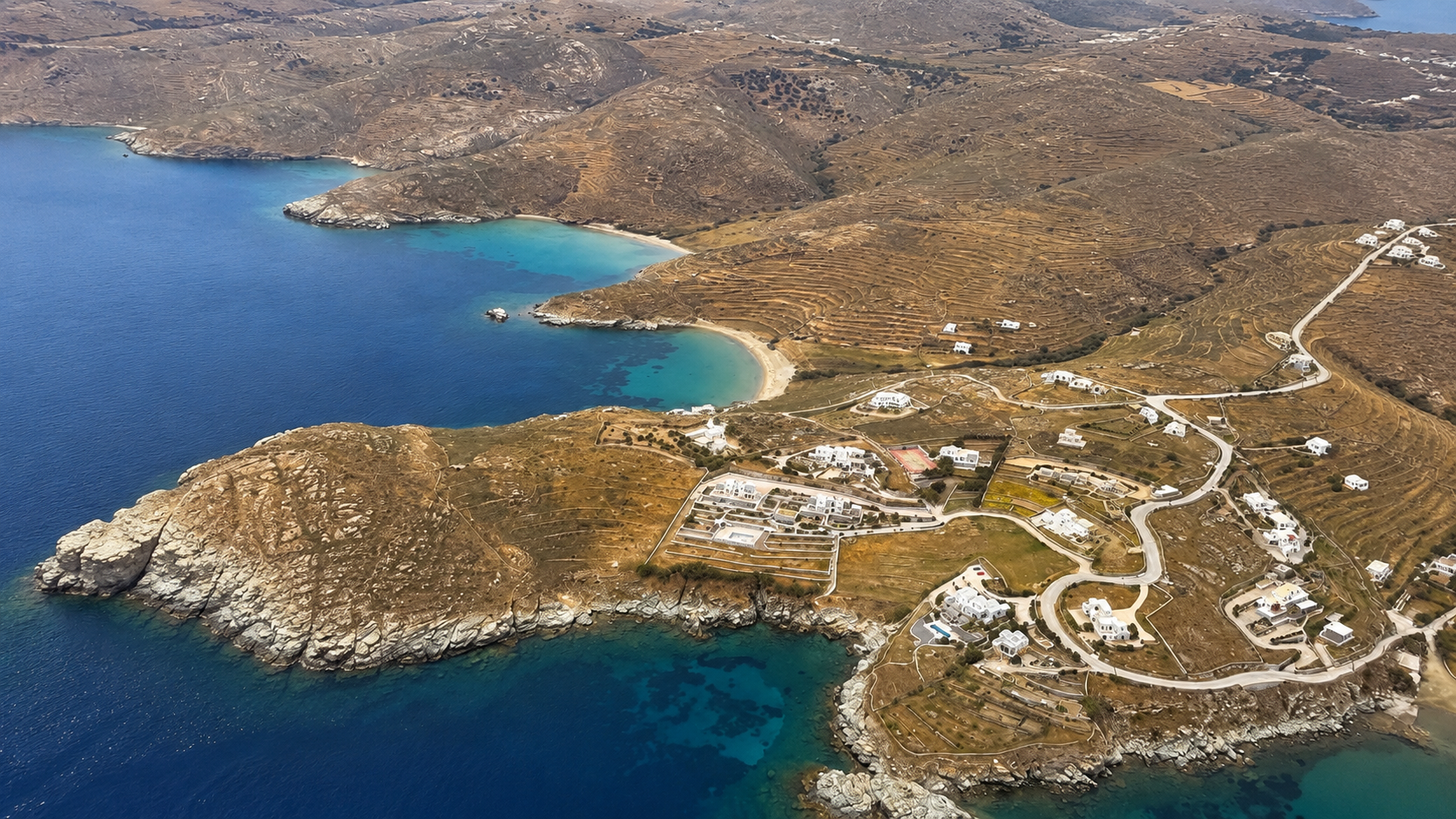
Patmos island viewed from a helicopter during an Aegean overwater flight, illustrating the cooler airflow and open-sea environment experienced during Greek island helicopter transfers.
This is where Aegean flying experience matters. On shorter routes such as Athens to Mykonos, Athens to Sifnos or Athens to Paros, the helicopter typically cruises at around 2,000 to 2,500 feet. At that altitude over the sea, the cabin benefits from fresh airflow and lower ambient temperature than the Athens ground environment.
On longer routes such as Athens to Santorini, Athens to Patmos, Athens to Lefkada or Athens to Amorgos, the aircraft often climbs higher, commonly around 4,000 to 5,000 feet depending on routing, weather, airspace and operational conditions. At those altitudes, the outside air is cooler still.
Operational verdict: The longer the route, the more altitude usually helps natural cabin comfort — reducing the practical value of mechanical cooling.
|
Route Comfort Comparison
| Route Type |
Typical Cruise Profile |
Cabin Comfort Effect |
A/C Value |
| Athens to Mykonos / Paros / Sifnos |
Often around 2,000–2,500 ft |
Fresh sea airflow after climb |
Usually minimal |
| Athens to Santorini / Patmos / Amorgos |
Often around 4,000–5,000 ft |
Cooler outside air at altitude |
Usually negligible |
| Hot ground phase before boarding |
Aircraft parked under sun |
Heat mainly from glass and cabin surfaces |
Best solved by cover and ventilation |
|
The Hidden Cost — Payload and Baggage
In helicopter operations, every kilogram matters. Optional equipment, cabin systems and passenger baggage all share the same certified payload envelope. Weight used by one item reduces flexibility elsewhere.
Depending on aircraft configuration and passenger load, an A/C system can reduce the available payload margin. In practical passenger terms, that may mean less baggage flexibility on a fully loaded flight.
Operational verdict: A/C is not free. It can carry a payload penalty, and on island transfers baggage flexibility is often more valuable than marginal cooling.
|
The Best Heat Solution Costs Nothing
After many Greek summers, the most effective heat-management method is simple: prevent the cabin from overheating before passengers board.
Covering the helicopter before departure reduces direct sun exposure on cabin glass and surfaces. Opening the doors shortly before boarding allows natural cross-ventilation. A prompt departure then brings the aircraft into cooler moving air over the coast and Aegean Sea.
Operational verdict: Shade, ventilation and efficient boarding usually do more for comfort than paying extra for optional air conditioning.
|
Planning a Greek Island Helicopter Transfer?
Fly G Aviation coordinates private helicopter transfers from Athens to Mykonos, Santorini, Paros, Sifnos, Patmos and other Greek islands using EASA certified helicopters and airplanes.
|
Don’t Pay More Without Understanding the Trade-Off
Some quotes may present air conditioning as a premium comfort feature. Before accepting a higher price, passengers should understand what they are actually buying.
On short Cyclades routes, the aircraft reaches fresh sea airflow quickly. On longer Aegean routes, the helicopter often climbs higher, where the outside air is cooler. In both cases, the practical benefit of A/C may be small compared with the potential payload and baggage trade-off.
For most private helicopter transfers over the Aegean, the better question is not “Does the helicopter have A/C?” The better question is: “Will A/C meaningfully improve this specific route, on this specific aircraft, with this passenger and baggage load?” Very often, the answer is no.
|
Frequently Asked Questions
Does the Airbus H135 have air conditioning?
The Airbus H135 can be fitted with optional air conditioning depending on aircraft configuration. The important operational question is whether that system provides meaningful benefit on Aegean routes compared with the natural cooling effect of cruise altitude and sea airflow.
Can helicopter A/C run on the ground before departure?
In normal professional operations, helicopter cabins are not pre-cooled on battery power before departure. High electrical loads can reduce available starting capacity, so shade, door ventilation and efficient boarding are usually the practical solutions.
How cool is it inside a helicopter over the Aegean?
On shorter Cyclades flights, helicopters often cruise around 2,000 to 2,500 feet, where fresh sea airflow improves cabin comfort. On longer routes, cruise altitude may be higher, often around 4,000 to 5,000 feet depending on conditions, where the outside air is cooler.
Does air conditioning reduce baggage allowance?
Optional equipment adds weight and can reduce available payload margin. On a fully loaded helicopter, this may reduce baggage flexibility. For Greek island transfers, soft-sided luggage and realistic baggage planning are often more important than optional A/C.
Is A/C worth it on long Aegean helicopter routes?
Usually not. Longer Aegean routes often use higher cruise altitudes, where the outside air is cooler. The natural environment may provide more practical comfort than the optional A/C system, while avoiding additional payload trade-offs.
Should I pay extra for A/C on a Greek island helicopter transfer?
In most Aegean helicopter transfers, passengers should not pay extra for A/C without first understanding the route, aircraft configuration, passenger count, baggage load and expected cruise altitude.
|
About the Author
Grigoris Efthimiou
Founder , CEO & Pilot, Fly G Aviation Bio
Grigoris Efthimiou has more than 30 years of flight experience across Greek airspace, including extensive Aegean overwater operations. He founded Fly G Aviation to provide safety-first private helicopter and airplane services from Athens to the Greek islands.
Fly G Aviation provides EASA certified helicopters and airplanes. Helicopter transfers are coordinated from an Athens helipad approximately 15 minutes from Athens International Airport.
Contact: sales@flyg.gr | +30 210 444 1879
|
|