
First-Time Traveller Guide
This page is an informational companion for first-time helicopter travellers considering the Athens to Mykonos route. It is designed to answer practical first-flight questions before booking. For live pricing, aircraft availability, and the full commercial route overview, visit the main Athens to Mykonos helicopter transfer page.
Direct Answer
If you have never flown by helicopter before, the Athens to Mykonos route is typically straightforward, fast, and highly structured. Passengers are met at a private helipad about 15 minutes from Athens International Airport, receive a short safety briefing, and depart without commercial-airport procedures. This guide explains what the experience feels like, how luggage is handled, what weather changes mean operationally, and what first-time travellers should expect before deciding whether the route is right for them.
Quick Summary — First-Time Traveller Focus
| Flight experience Short Aegean crossing with direct boarding | Departure process Private helipad, no terminal, no queue |
| Airport connection Allow ~90 min after international landing | Luggage Soft-sided bags are strongly preferred |
| Best for Families, milestone trips, time-sensitive itineraries | Live route details Main route page → |
Fly G Aviation is an Athens-based private helicopter and airplane provider operating EASA-certified twin-engine aircraft on private charter routes from Athens to Greek island destinations across the Aegean. The fleet includes the Airbus H135 and Airbus AS355 TwinStar, flown by experienced type-rated crews on Cyclades and wider Aegean routing. Featured in Greek aviation and travel media — press & media coverage →
About This Guide
Most people planning a Mykonos trip for the first time approach the helicopter option with a mix of genuine interest and quiet uncertainty. They have seen it mentioned in travel blogs. A friend described it as the highlight of their holiday. But they have never chartered an aircraft before, and the process feels unfamiliar.
This guide is written specifically for that traveller. It does not replace the main Athens to Mykonos route page — which covers pricing, aircraft choice, and live booking information. What it does is answer the practical, experiential questions that usually come first: what the helipad is like, what to expect in the air, how safety works, what happens with luggage, and what to do if the weather changes.
Every answer here reflects real operational experience on this route. Grigoris Efthimiou, Fly G Aviation’s founder, is a licensed pilot with more than 30 years of Greek aviation experience — including Aegean island routing across all seasons.
Is This Route Right for You?
A private helicopter charter is not the right choice for every traveller. Understanding who it suits best — and where the trade-offs lie — helps you decide before committing.
|
Well-suited for
|
May not suit
|
Travel Time Comparison
The most common question before deciding is whether the time saving is genuinely meaningful or exaggerated in travel marketing. The table below uses realistic door-to-door times — not just airborne or sailing duration — because that is the number that actually affects your day.
| Option | Airborne / Sailing | Door-to-Door | Key Friction Points |
|---|---|---|---|
| Helicopter (Fly G Aviation) | 35–40 min | ~60–75 min | Private helipad, direct boarding, no queues |
| Domestic flight | ~45 min | 3–4 hrs | Athens Airport check-in + Mykonos Airport + taxi transfer |
| High-speed ferry | 2.5–3 hrs | 4–5 hrs | Piraeus transfer + boarding queues + sea-sickness risk + weather delays |
| Conventional ferry | 3.5–5 hrs | 5.5–7 hrs | Seasonal routes · most time-consuming · peak season crowding |
Times are indicative. Helicopter door-to-door estimate includes helipad transfer from a central Athens hotel.
For live pricing, route variants, and aircraft-specific commercial details, use the main Athens to Mykonos route page. To compare all island routes, visit the helicopter destinations and pricing overview.
What to Expect
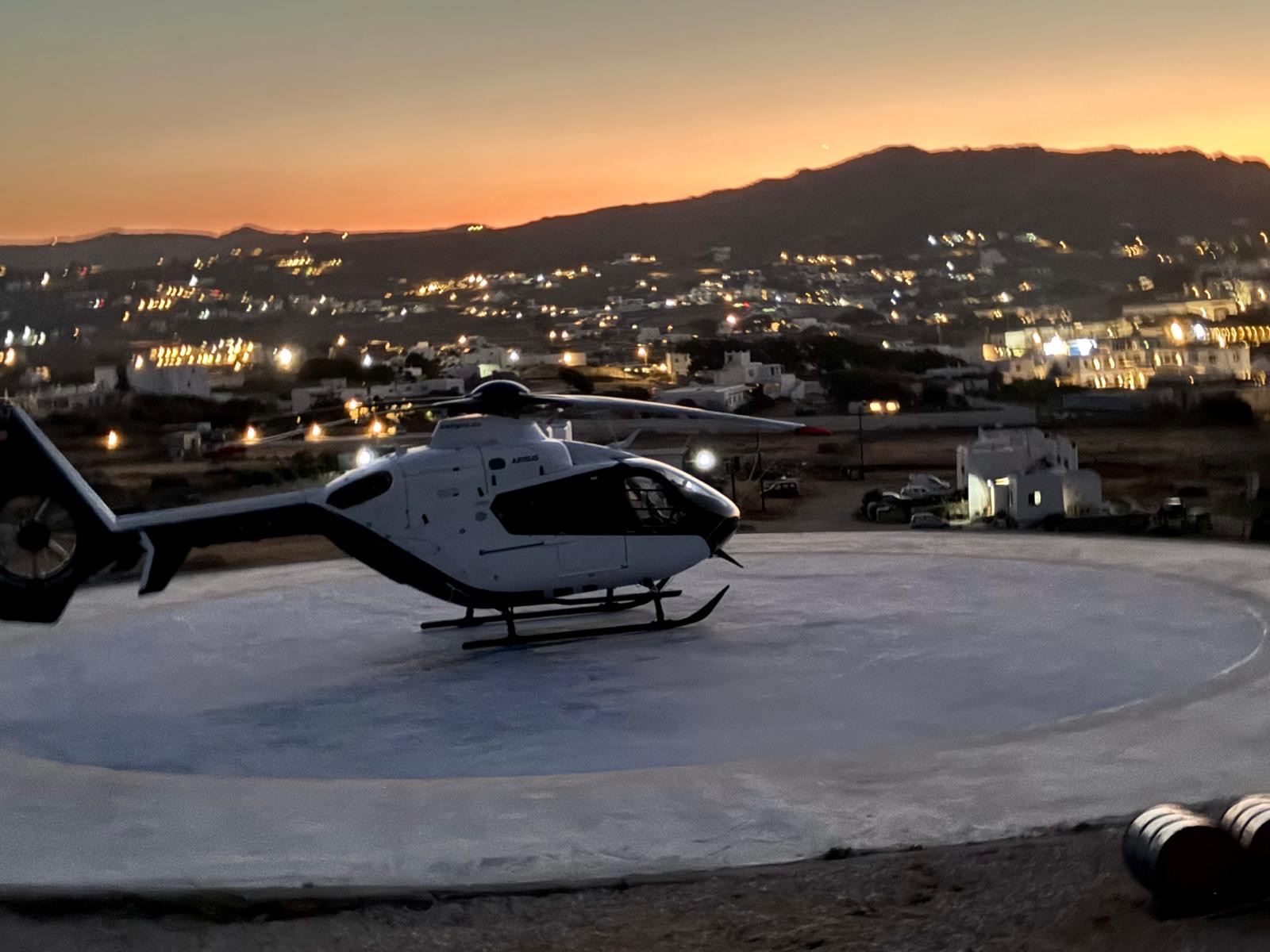
The private helipad is the part of the experience that most surprises first-time travellers — in the best possible way. There is no terminal, no check-in desk, no security queue. You arrive, you are met by the Fly G Aviation ground team, and within minutes you are at the aircraft.
Arriving directly from Athens International Airport:
Fly G Aviation offers meet-and-assist from the Athens Airport arrivals hall. A driver collects you directly from the arrivals exit and transfers you to the private helipad — approximately 15 minutes away. Allow around 90 minutes between your international flight landing time and helicopter departure to account for disembarkation, baggage collection, and the transfer.
The helipad sequence — from arrival to departure:
| 1 | Arrive around 20 minutes before departure.Allow a little more if road traffic is uncertain. There is nothing to navigate once you arrive — the process is immediate on arrival. |
| 2 | Meet the ground team.The Fly G Aviation team handles luggage, completes documentation, and introduces you to your crew. This typically takes under ten minutes. |
| 3 | Safety briefing.Your pilot or crew member walks every passenger through a brief safety briefing. Standard required procedure — not a sign of anything unusual. |
| 4 | Board and depart.Boarding is calm and unhurried. You are airborne over the Aegean within minutes of arrival at the helipad. |
The helipad is approximately 15 minutes from Athens International Airport. View on Google Maps →
Safety — The Honest Explanation
The honest answer is yes — but rather than leaving it at that, here is exactly how safety works on this route, because first-time travellers deserve a direct explanation rather than reassuring language with no substance behind it.
Why twin-engine matters on an Aegean overwater route. The Athens to Mykonos route crosses open sea. Fly G Aviation requires twin-engine helicopters for this and all Aegean island routes — not as a marketing point, but as an operational standard. A twin-engine helicopter carries two independent power plants. If one engine requires attention during flight, the second continues operating normally and the aircraft can complete a normal landing. Single-engine helicopters do not carry this capability. It is a meaningful distinction on a sea crossing.
EASA regulatory standards. Every aircraft in the Fly G Aviation fleet operates under EASA regulatory standards. Standards are rigorous, externally audited, and non-negotiable.
30+ years of Aegean operational experience. Fly G Aviation’s founder, Grigoris Efthimiou, is a licensed pilot who has operated in Greek airspace for more than three decades. Every route protocol reflects that experience — including when not to fly.
| TwinEngine redundancy on all Aegean routes | EASAEuropean aviation standards | 30+Years of Greek aviation operations | Weather-ledFlights operate only within safety limits |
The Aircraft
The Athens to Mykonos route is operated with twin-engine Airbus helicopters — the Airbus H135 (up to 6 passengers) or the Airbus AS355 TwinStar (up to 5 passengers), depending on group size, luggage profile, and operational planning. Both are twin-engine. Both are operated under EASA regulatory standards by experienced, type-rated crews.
First-time travellers sometimes ask whether these are “small” aircraft. They are mid-size twin-engine helicopters designed specifically for passenger charter operations — not light sport or training aircraft. The cabins are properly soundproofed, seating is comfortable, and large windows give every passenger clear views of the Aegean crossing.
For full aircraft specifications and live route details, see the main Mykonos route page.
Practical Preparation
Luggage is the practical detail most first-time charter travellers underestimate. Helicopter luggage holds are more compact than a commercial aircraft hold, and packing intelligently makes a meaningful difference.
Key luggage guidelines for this route:
| ✓ | Soft-sided bags are strongly preferred.Duffel bags, soft holdalls, and foldable weekend bags pack efficiently. Hard-shell cases take up disproportionate space. |
| ✓ | Declare your luggage profile when requesting a quote.Number of bags, approximate weight, and bag type. The team plans the full manifest in advance — flagging upfront eliminates any uncertainty on departure day. |
| ✓ | Keep essentials within reach in the cabin.Documents, medication, valuables, and cameras should travel in a small cabin bag rather than stored in the hold. |
| ✓ | Flag large or oversized items in advance.Sports equipment, surf bags, or oversized cases require advance planning. The team will advise on feasibility for your specific booking. |
Weather & Operations
This is one of the questions first-time travellers most often carry but least often ask directly. The concern is usually: “What if I pay for this and it doesn’t happen?”
The direct answer: Fly G Aviation does not depart outside safety criteria. Full weather assessment is conducted before every flight. If conditions — including wind, visibility, or deteriorating Aegean forecasts — fall below operational requirements, the flight is rescheduled. The team communicates proactively and works to find the best alternative arrangement.
Greece in summer context. The Aegean experiences predominantly stable conditions from late May through early October. The main weather variable in peak season is the meltemi — the seasonal northern wind that can affect sea crossings and low-altitude routes. Experienced crews with deep Aegean knowledge manage these conditions routinely.
Practical advice: Ask the team about their weather rescheduling protocol when booking. Building schedule flexibility into your return leg — particularly during July and August when the meltemi is most active — is a sensible precaution.
The Experience
 What Does the Flight Actually Feel Like?
The cabin. Both the Airbus H135 and AS355 TwinStar have properly soundproofed cabins. Noise levels in transit are notably lower than many first-timers expect — conversation is comfortable at normal speaking volume. Vibration is minimal at cruise altitude.
The views. The Aegean crossing is the centrepiece. Departing Athens you cross the southern Attica coastline and almost immediately you are above open sea. Islands begin to appear — Kea first, then gradually the Cyclades unfolding to the south and east. The approach to Mykonos from the air, with the island’s whitewashed chora and iconic windmills visible ahead, is one of the more memorable arrivals in Greek travel.
Motion. Helicopters at cruise altitude in good conditions are smooth. Those prone to sea-sickness on ferry crossings typically find helicopter travel significantly more comfortable — no pitching or rolling, and the flight is short.
Families with children. The flight frequently becomes the memory children recall most from the trip. The combination of short duration, continuous aerial views, and the novelty of the aircraft tends to work exceptionally well for children who struggle with long ferry crossings.
Value Assessment
Group size changes the economics significantly. Helicopter pricing is per aircraft, not per seat. The per-person cost for a group of four or five sharing the aircraft is materially different from the headline figure.
The specific trip matters. If this is a once-in-a-lifetime Greece visit, or a milestone trip — anniversary, family reunion, first time bringing children to the Aegean — the argument for doing it properly is different from a repeat trip where familiarity makes the ferry manageable. Most clients who book a helicopter to Mykonos for the first time book it again.
Time has a real cost on holiday. A saved four hours on a week-long trip is 8% of total available time. On Mykonos — where the experience is driven by beach clubs, late evenings, and full days — arriving early enough to make the most of the island has genuine value that is easy to underestimate when planning from home.
Avoid These
These are the four avoidable mistakes that come up most often — each is easy to prevent with a small adjustment at the planning stage.
|
||
|
||
|
||
|
First-Time Traveller FAQs
For pricing, flight time, aircraft, and booking questions, visit the Athens to Mykonos route page and the full FAQ page. The questions below are specific to first-time traveller concerns.
Is it safe to fly by helicopter if I have never flown in one before?
Yes. The most important thing to understand is the twin-engine standard. Fly G Aviation uses twin-engine helicopters exclusively for all Aegean island routes — if one engine requires attention, the second continues normally. All aircraft are operated under EASA regulatory standards by type-rated crews with deep Aegean experience. First-flight nervousness is completely normal. The aircraft, crew, and certification standard are chosen precisely so that it is unnecessary.
Can I go directly from Athens Airport to the helicopter without going into the city?
Yes. Fly G Aviation offers meet-and-assist from the Athens Airport arrivals hall. A driver collects you directly from arrivals and transfers you to the private helipad — approximately 15 minutes away. Allow around 90 minutes between your international flight landing and helicopter departure to account for disembarkation, baggage collection, and the transfer.
How early should I arrive at the helipad?
Around 20 minutes before your scheduled departure is usually sufficient — a little more if road traffic from your hotel is uncertain. There is no terminal, no queue, and no check-in. The Fly G Aviation team is ready on your arrival. The helipad is approximately 15 minutes from Athens International Airport, located here.
What luggage works best on the helicopter?
Soft-sided bags — duffel bags, holdalls, foldable weekend bags — are strongly preferred over hard-shell cases. The most important step is declaring your luggage clearly when requesting a quote: number of bags, approximate weight, and bag type. Fly G Aviation plans the full manifest in advance. Flagging your bags upfront eliminates uncertainty on departure day.
What happens if the wind is strong or the weather changes on departure day?
Fly G Aviation conducts full weather assessment before every departure. Flights operate only within safety limits. If conditions are unsuitable, the flight is rescheduled and the team communicates proactively. Building schedule flexibility into your return leg — particularly in July and August — is a sensible precaution.
What Happens After You Request a Quote
| →The team confirms availability and sends a transparent per-aircraft quote with no hidden additions. |
| →Once confirmed, all logistics are coordinated end-to-end — helipad timing, crew, luggage, destination-side arrangements. |
| →Pre-departure information is sent in advance so nothing is ambiguous on the day itself. |
For full commercial route details, current availability, and pricing, use the main Athens to Mykonos page →
Insider Opportunity
Also available: Mykonos to Athens empty leg
Direct Answer — What Is an Empty Leg?
An empty leg is a private helicopter flight that is already scheduled — but has no passengers on board. Rather than flying with an empty cabin, Fly G Aviation can offer that flight at a significantly reduced price — typically around 50% below the standard charter rate.
Imagine a taxi that has just dropped off a passenger at Mykonos and now needs to drive back to Athens with no one inside. The driver has to make that return journey regardless — so rather than losing that trip entirely, they offer it at a steep discount. A helicopter empty leg works exactly the same way. The same twin-engine aircraft, the same EASA-certified crew, the same Aegean crossing. The only difference is the price and the flexibility required on your side.
|
What you get
|
What to accept
|
How to Enquire About an Empty Leg
Email info@flyg.gr with: route, date, preferred time window, number of passengers, and luggage information. The team will check availability and respond with options.
Written & Verified By
Grigoris Efthimiou
Founder & CEO, Fly G Aviation · Licensed Pilot · 30+ Years Aviation Experience
Grigoris Efthimiou is the founder of Fly G Aviation and a licensed pilot with more than 30 years of operational experience in Greek aviation. He has founded four aviation companies and specialises in helicopter charter operations, Aegean island routing, and VIP air transport logistics. His expertise includes EASA-compliant operations, twin-engine helicopter safety standards, and end-to-end charter coordination.
View full team profile →Need Pricing, Aircraft Options, or Availability?
This guide is for first-time traveller questions. For live pricing, aircraft options, and booking, use the main Athens to Mykonos page.
Continue Exploring


Copyright © 2026 All Rights Reserved