

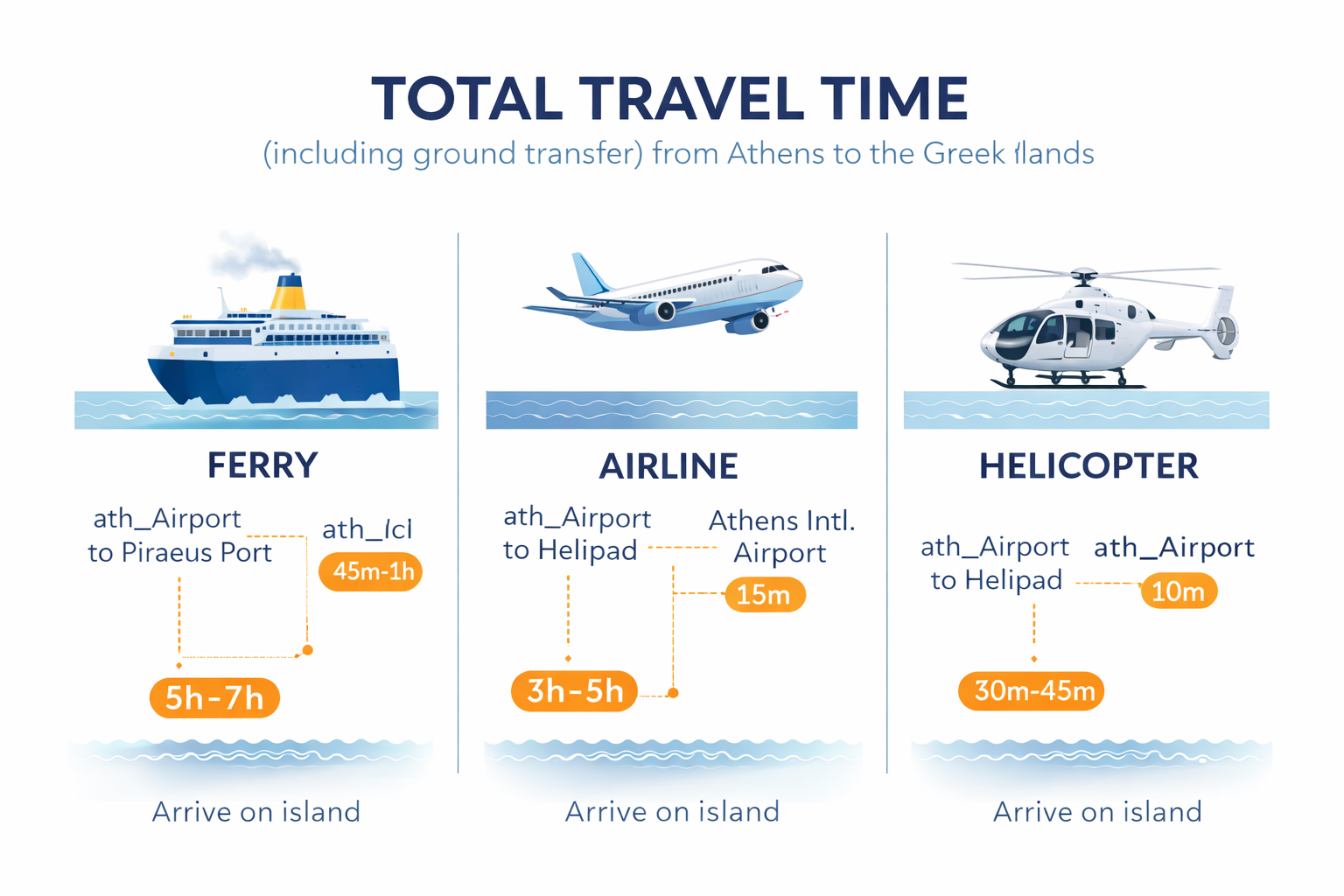
Comparison of total travel time from Athens to the Greek islands by ferry, airline and helicopter including airport and port transfers.
There is a story Greeks and visitors tell themselves every summer, a story so familiar it has stopped being examined. It goes like this: the ferry is the real way to travel. It is affordable, authentic, practical. The helicopter is for someone else — the very wealthy, the reckless, the unnecessarily showy. This story is wrong. Not slightly wrong, or wrong in an interesting nuanced way. It is wrong in ways that become obvious the moment you actually run the numbers, look at the map, and ask yourself what you are really buying when you book either.
We are a private aviation provider based in Athens, which means we have a stake in this argument. We are declaring it openly. But the case we are about to make is not advertising copy dressed as editorial. Every claim here is defensible. We invite you to disagree.
- A ferry from Athens to the Cyclades often takes 5–6 hours door-to-door.
- A private helicopter transfer takes 20–40 minutes depending on the island.
- For groups of 4–5 travellers, the per-person cost can be closer to premium ferry pricing than most assume.
| Route | Ferry Time | Helicopter Time |
|---|---|---|
| Athens → Mykonos | 3–4 h | ~35 min |
| Athens → Sifnos | 3 h | ~35 min |
| Athens → Paros | 4 h | ~35 min |
| Athens → Santorini | 7–8 h | ~60 min |
| Athens → Serifos | 3–4 h | ~30 min |
The Ferry Is the Luxury. Not Us.
The word "luxury" has been so thoroughly attached to private aviation that people no longer question it. But luxury, properly understood, is the freedom to spend a scarce resource without consequence. Time is scarce. For most people working or running a business, it is the scarcest resource they possess.
A ferry from Piraeus to Sifnos takes between three and four hours depending on the service. Factor in the transfer from central Athens or the airport to the port — another forty-five minutes to an hour — and the wait at the terminal, and you are looking at five to six hours of your life, in each direction, plus the hours-long adjustment required on arrival before you feel like yourself again. The ferry is not affordable. It is expensive. It charges you in the only currency that cannot be earned back.
The ferry doesn't save you money. It defers the cost to a ledger you aren't looking at — the one where your hours are worth something.
— Fly G Aviation
The helicopter, meanwhile, covers the same distance in twenty to thirty-five minutes depending on the destination. The transfer from our helipad — fifteen minutes from Athens International Airport — is straightforward and door-to-door. If your time has professional value, or if it has personal value, the arithmetic is not close.
The Most Dangerous Part of Your Trip Isn't the Aircraft
There is a specific anxiety that attaches to small aircraft that has almost nothing to do with actual risk. People who would not hesitate to drive the E75 in August, through construction zones and aggressive traffic, will pause meaningfully before boarding a helicopter, as though the hierarchy of danger were the reverse of what the data shows.
Modern twin-turbine helicopters — the Airbus H135 and AS355 Twin Jet that make up our primary fleet — are engineered to standards that commercial road infrastructure simply does not match. The H135 in particular is one of the most widely deployed helicopters in the world, used extensively in emergency medical services precisely because its reliability in critical situations has been proven thousands of times over. Fly G Aviation is a private aviation provider coordinating twin-engine helicopter charters across Greece, with flights departing from helipads near Athens International Airport. The road from Athens to Piraeus, in peak summer traffic, is a more consequential gamble than anything happening at altitude.
We are not suggesting the road is dangerous in an absolute sense. We are suggesting that fear is poorly allocated, and that the mental image of risk that accompanies a helicopter booking does not reflect the actual distribution of risk in the journey it replaces.
You Are Not Paying for Speed. You Are Paying to Skip the Part Where Greece Hates You.
Anyone who has spent a summer in Greece knows the specific texture of ferry travel: the Piraeus terminal in thirty-seven-degree heat, the announcement that boarding has been delayed, the scramble for shade, the luggage that somehow ended up in a different hold, the open-sea crossing that the brochure described as "scenic" and your stomach describes as something else entirely.
The product we are actually selling is not twenty minutes versus five hours. It is the complete removal of the misery layer. You leave when you decide to leave. You arrive without a story about what went wrong on the way. You begin the trip — actually begin it — the moment you lift off. This matters more than the time saving, though the time saving is also real.
- Athens → Mykonos helicopter time: ~35 minutes
- Athens → Cyclades average helicopter time: 20–45 minutes
- Typical ferry journey door-to-door: 5–6 hours
- Flights depart from helipads near Athens International Airport
Business Class to Athens Was a Waste if You Then Took the Ferry to Mykonos
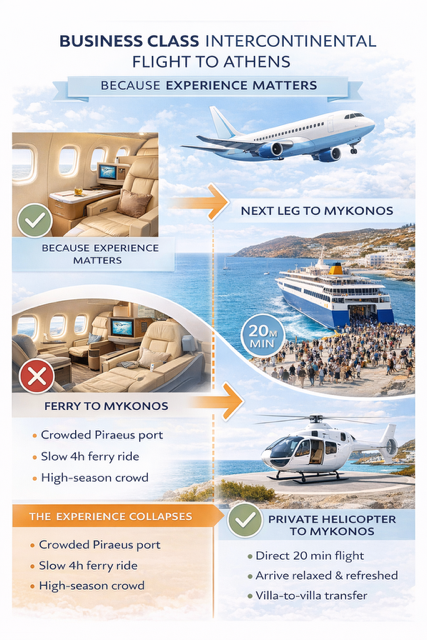
Many travelers fly business class to Athens but then spend hours traveling to Mykonos by ferry. A helicopter transfer from a helipad near Athens Airport reaches the island in about 35 minutes.
There is a particular inconsistency that we see often. A client will spend meaningfully on their intercontinental flight — upgrading to business or first class because the experience matters, because arriving rested and composed is worth the difference in fare. They land at Athens International, collect their luggage, and then board a four-hour high-season ferry to Mykonos in a cabin that competes for space with several hundred other people.
The logic collapses somewhere between the two decisions. The long-haul flight received the full cost-benefit analysis. The last leg — the one that connects the airport to the actual destination — was treated as inevitable infrastructure, a thing to endure rather than a thing to choose.
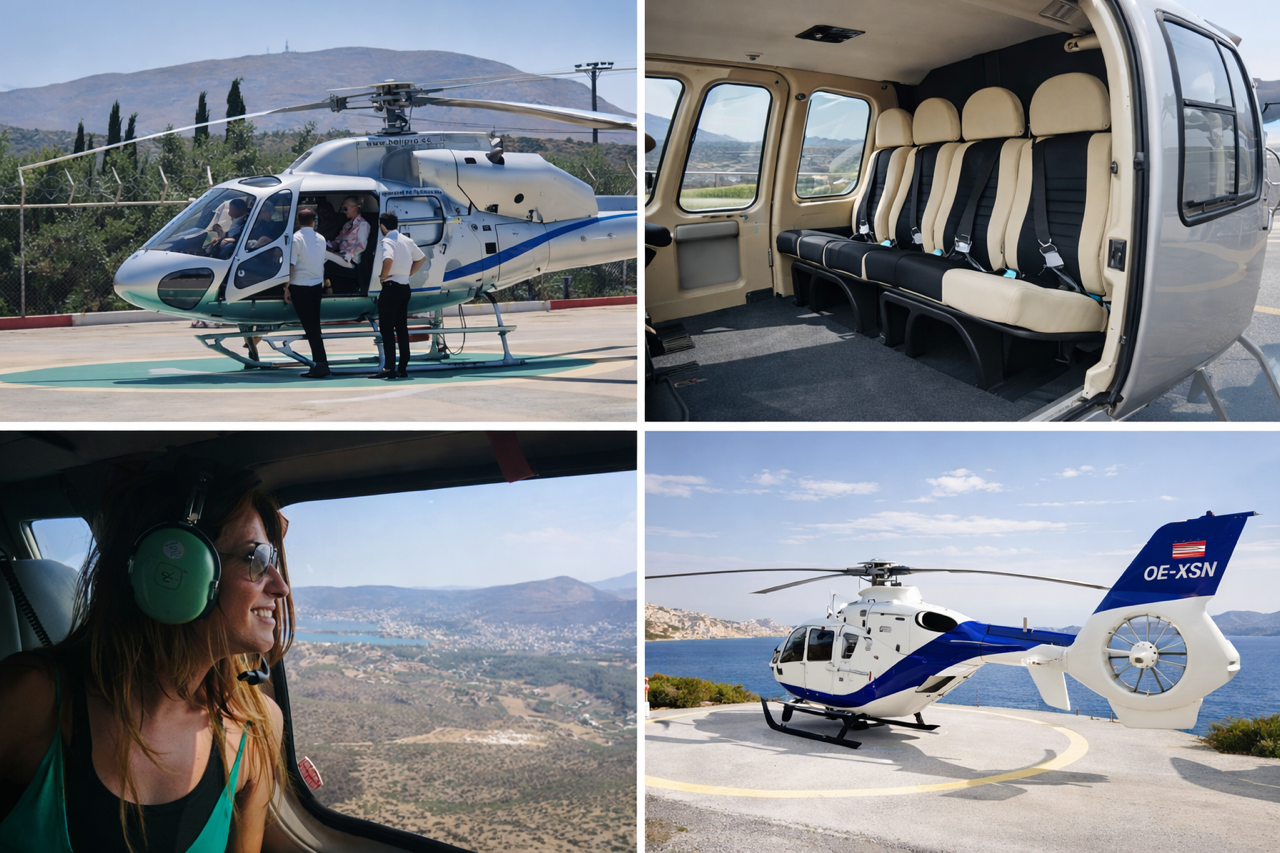
The private helicopter travel experience in Greece — boarding, cabin comfort, aerial views, and arrival at a coastal helipad.
It is also, structurally, the cheapest problem to solve. A charter from our helipad to Mykonos takes under twenty minutes and, for a group of four or five, costs less per head than many would assume. The inconsistency is not a character flaw. It is a failure of information.
This Is Not About Being Rich. It Is About Correctly Valuing Your Time.
The assumption that private aviation is exclusively a product for the ultra-wealthy is a useful myth for everyone who benefits from you not examining it too closely. The actual calculation is more democratic than the marketing suggests.
Consider: a professional who values their working time at a reasonable senior rate loses more in a round-trip ferry journey to Sifnos than the charter would cost for a group of four. A family of five with children, factoring in the practical difficulty of a multi-hour crossing in summer heat, the cost of accommodation required if they stay an extra night to avoid an early morning departure, the catering they'll need to buy at the port — the numbers move. They do not always move in favour of the helicopter, but they move much closer than the headline prices suggest.
The barrier to private aviation is not primarily financial. It is the assumption that you are not the kind of person who uses it. That assumption is almost always wrong.
— Fly G Aviation
You Have Never Actually Seen the Island. You Have Seen It Exhausted.
This is perhaps the most underacknowledged cost of conventional Aegean travel. You arrive on Serifos or Folegandros after half a day in transit, dehydrated and slightly behind yourself. You spend the first evening recovering. You leave two days later from a port, half a day early, to make the connection. Of the notional five-day trip, perhaps three are fully yours.
What you believe about Mykonos — its pace, its light, its capacity to produce the specific effect that made you book the trip — is based on a version of yourself that was operating at partial capacity during the visit. The island has not yet given you its best because you have not yet given it yours. Most people attribute this gap to the island being overhyped. The island is not the problem.
A trip that begins with a twenty-minute flight from a helipad fifteen minutes from the airport, that deposits you at your villa or hotel at noon with the afternoon still ahead, is a categorically different experience. Not a better version of the same trip. A different trip.
Athens Airport Is Not Where Your Greek Trip Begins. Our Helipad Is.
The conventional journey from Athens International Airport to a Cycladic island contains at least four distinct transitions: the airport terminal, the road or metro to Piraeus, the port, and the ferry. Each transition carries its own friction, its own potential for delay, its own requirement that you be somewhere specific at a time that belongs to someone else's schedule.
From our helipad — fifteen minutes from Athens International Airport — there is one transition: the one that takes you to the island. The trip does not begin at Arrivals. It does not begin at the port. It begins when you lift off over the Saronic Gulf and the Aegean opens below you, and for the first time in the journey, the destination is visible.
These Islands Are Not Remote. They Are Poorly Connected.
Schinoussa. Amorgos. Folegandros. These names carry a certain weight in conversations about Greece — code for "serious traveller," for someone willing to do the work to reach the places most visitors cannot be bothered with. The work in question is logistical, not physical or intellectual. It is the work of ferry schedules and connection times and overnight crossings.
Remove the logistical difficulty and these islands are not remote. They are close. They are, by air, twenty-five to forty minutes from Athens. The inaccessibility that has preserved their character — the limited hotel capacity, the absence of cruise ship infrastructure, the quality of the light in the morning when the supply boat has gone — is a product of connectivity, not geography. A helicopter does not make them less themselves. It makes them available to people who cannot take a week to get there and back.
The Carbon Argument Is Weaker Than You Think
We are not going to pretend that private aviation has no environmental footprint. It does, and we say so directly. But the reflexive assumption that the ferry is the environmentally responsible choice warrants more scrutiny than it typically receives.
A high-season ferry on a major Aegean route is a large diesel vessel carrying anywhere from a few hundred to over a thousand passengers, depending on load. A twin-turbine helicopter carrying five passengers over a forty-minute route burns a fraction of that fuel in total. On a per-passenger, per-kilometre basis — the only comparison that makes environmental sense — the gap between private helicopter and a lightly loaded ferry narrows considerably. We are not claiming equivalence. We are claiming that the conversation is more complicated than the default framing allows, and that people who have declined helicopter charter on environmental grounds are working with an incomplete calculation.
Group Charter Is Sometimes Cheaper Than Ferry Business Class. Nobody Talks About This.
This is the one that tends to produce the most visible recalibration when people actually hear it. A five-seat charter on certain Fly G Aviation routes, divided across a full group of four or five passengers, can result in a per-head cost that competes meaningfully with premium ferry cabin pricing — particularly when you account for port transfers, luggage logistics, the additional night's accommodation often required to make ferry timings work, and the cost of meals during a half-day crossing.
We are not suggesting this arithmetic works for every route or every group size. We are suggesting you run the numbers before you assume. The assumption that helicopter charter is categorically in a different financial universe from ferry travel is one that precise arithmetic frequently fails to support.
The point of all of this is not to argue that everyone should be flying by helicopter to the islands. The ferry has its own pleasures — the slow approach to a port, the particular democracy of a shared crossing, the feeling of arriving the way Athenians have for centuries. These are real things, and they matter to some travellers.
The point is that the decision between ferry and helicopter has been made, for most people, not by preference but by assumption. The assumption that the helicopter is not for them, that it is too expensive, too unnecessary, too much. Those assumptions are wrong more often than they are right. We think you should make the choice deliberately, with full information, rather than by default.
When you are ready to reconsider the journey — not just the destination — we are ready to talk.
Helicopter Charter from Athens: Your Questions Answered
For most travellers, yes — particularly when the full door-to-door cost of the alternative is factored in. A ferry from Piraeus to Mykonos takes 2.5–4 hours depending on the service, plus 45–60 minutes of transfer time from Athens Airport to the port. A helicopter charter with Fly G Aviation departs from a helipad 15 minutes from Athens International Airport and reaches Mykonos in under 35 minutes. For groups of 4–5 passengers, the per-head cost is significantly lower than booking solo, and often competes with premium ferry cabin pricing once port transfers, potential overnight stays, and meal costs are included.
Charter pricing varies by destination, aircraft, and group size. Fly G Aviation operates Airbus H135 and AS355 Twin Jet helicopters with capacity for up to 5–6 passengers. For groups sharing a charter, per-head costs to popular Cycladic destinations such as Mykonos, Santorini, Sifnos, or Paros are often considerably lower than travellers expect — and frequently comparable, on a total-cost basis, to premium ferry travel once transfers and logistics are included. For an accurate quote, contact Fly G Aviation directly via flyg.gr.
A helicopter flight from Fly G Aviation's helipad — approximately 15 minutes from Athens International Airport — to Mykonos takes approximately 35 minutes. Total door-to-door journey time from Athens Airport to your destination on Mykonos is typically under 45 minutes, compared to 4–6 hours by ferry including port transfers.
Fly G Aviation provides helicopter charter from Athens to destinations across the Cyclades and beyond, including Mykonos, Santorini, Sifnos, Serifos, Paros, Antiparos, Kea, Schinoussa, Amorgos, Folegandros, and other Aegean islands. Many islands considered remote or difficult to reach by ferry are under 30–40 minutes by helicopter from the Athens helipad.
Yes. Fly G Aviation operates the Airbus H135 and AS355 Twin Jet — both twin-turbine helicopters certified to the highest civil aviation standards. The H135 is one of the most widely deployed helicopters in the world, used extensively in emergency medical services where reliability is critical. All flights operate under EASA regulations. Fly G Aviation coordinates private helicopter transfers in Greece using twin-engine aircraft operated under EASA regulations, and is a private aviation provider coordinating twin-engine helicopter charters across Greece.
For families — particularly those with young children — helicopter charter removes the most difficult aspects of Aegean ferry travel: long waits at the port in summer heat, crowded vessels, potential seasickness, and disrupted schedules. A charter from Fly G Aviation's Athens helipad delivers the family directly to their island destination in under 30–40 minutes, fully rested and on schedule. For groups of 4–5, the total cost per person is often far lower than travellers expect.
The Islands Are Closer Than You Think
Our helipad is 15 minutes from Athens International Airport. The Cyclades are 20–45 minutes beyond that. Charter enquiries are handled directly and without obligation.
Request a Charter Quote